Stay informed
SIWI newsletter
Receive SIWI’s latest news, events, reports and jobs directly in your inbox.
You can unsubscribe at any time.

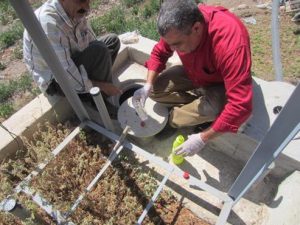
Many people in Ramallah, Palestine depend on local springs to meet their water needs and face dangers of being exposed to contaminants from untreated and improperly disposed wastewater. Where centralized waste water treatment facilities are too costly to build and operate, decentralized systems can provide viable alternative solutions. They can also provide solutions to improve water use efficiency by utilizing safe greywater for irrigation. The EDM projected demonstrated the use of such a decentralized greywater treatment facility at the Deir Ammar Club in Ramallah, which sought to serve a local community of 500 people and also provide a model to serve as a catalyst for similar projects in the country.
Title: Construction of onsite grey wastewater treatment plant at Deir Ammar Club
Implementation period: 2011-2012
Implementing agency: House of Water and Environment
Location: West Bank, Ramallah
Budget: 111,000 USD (EDM: 40,000 / Co-financing: 70,000)
Discharging untreated wastewater into channels running through farmland is causing serious environmental problems in Palestine, especially when this water is used to irrigate crops. Over the last 50 years, an untreated wastewater stream near Hebron city with a total length of 44 km – passing through 18 Palestinian communities – has polluted 685 hectares of agricultural land. The affected land is seriously polluted with chromium (a cancer causing heavy metal) levels in the soil five times higher than the safe limit. This devastates the surrounding environment, and makes it unsuitable for people to live in.
Furthermore, the stream has had a drastic effect on the economy by destroying huge areas of cropland and grazing land. The EDM project introduced a solution that is both safe and economically sustainable: it planted groves of eucalyptus trees so that the untreated wastewater can be used to produce wood instead of food. It also made all data publicly available for similar projects, academics, and decision makers, both raising awareness and enabling scaling up in other communities.
Title: Use of Wadi Al-Samin wastewater stream in producing woody plants
Implementation period: 2011-2012
Implementing agency: Land Research Center
Location: Dura, Rabud and Karma
Budget: 46,670 USD (EDM: 35,000 / Co-financing: 11,670)