Stay informed
SIWI newsletter
Receive SIWI’s latest news, events, reports and jobs directly in your inbox.
You can unsubscribe at any time.

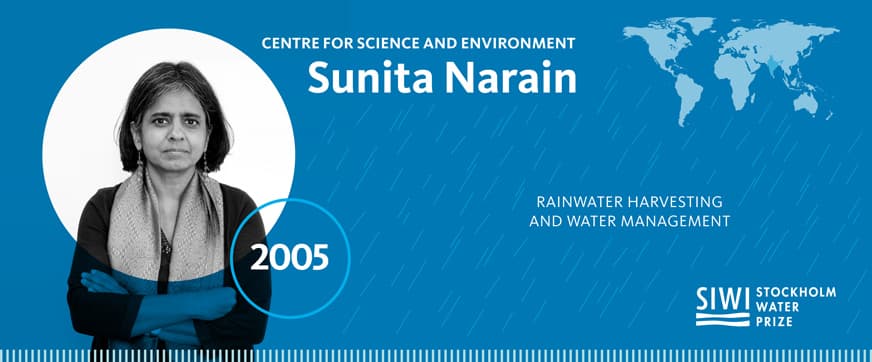
As CSE’s rainwater harvesting website proclaims, “The supply is in the sky.”
The world, she says, faces a critical challenge is improve the productivity of rain fed and marginalised lands. In this challenge, water can turn a large part of the country’s currently parched lands into productive lands, reduce poverty and increase incomes where it is needed the most. CSE has shown through its advocacy that localised water management is a cost-effective approach and more importantly that local water management – harvesting and storing water where it falls – can only be done through community participation.
The work of CSE has highlighted that water cannot become everybody’s business until there are fundamental changes in the ways we do business with water. Policy will have to recognise that water management, which involves communities and households, has to become the biggest cooperative enterprise in the world. For this, the organisation forcefully argues that the prevalent mindset that water management is the exclusive responsibility of government must give way to a paradigm built on participative and local management of this critical life source. This powerful idea is gaining ground to become the policy and practice in many regions of the world.
The 2005 Prize acknowledged CSE’s contribution to build a water-literate society that values the raindrop and teaches society to learn from the frugality of our ancestors, to build a water prudent world. The movement has the potential to change the water futures of the world. Two eye-opening CSE books – “Dying Wisdom: Rise, Fall and Potential of India’s Water Harvesting System” (1997) and Making Water Everybody’s Business (2001) – helped spawn a rediscovery of this practical, traditional and inexpensive technique to capture rainwater for drinking, sanitation and agricultural purposes, and to help alleviate pressure on India’s inefficient, centralised water system – itself a remnant of colonial times.
But CSE’s work hasn’t just been limited to water. The company has tackled issues from global climate change to the scrutinising of different Indian industries. It’s goal has always been to distinguished itself in the global crowd of NGOs through its insistence on hard facts before rhetoric. This philosophy has given the Centre considerable social capital within civil society, politics and the media in the push for policy change. CSE uses media outreach and information dissemination effectively to support its advocacy. The Centre produces an impressive and steady output of timely publications and other learning aids, including the fortnightly magazine, “Down to Earth”. The magazine has become an important voice of the practitioners of hope and change. Established in 1980, CSE now has 125 employees.