Stay informed
SIWI newsletter
Receive SIWI’s latest news, events, reports and jobs directly in your inbox.
You can unsubscribe at any time.

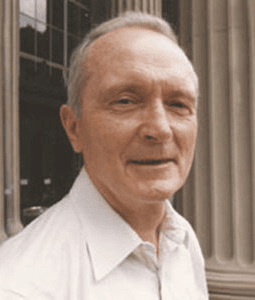
Peter-Eaglesor-SWP-1997
What makes Professor Peter S. Eagleson special is that he is no traditional hydrologist; he is also at ease with Darwinian ecology and mathematics.
He did so in 1970, for example, when he published his book Dynamic Hydrology, which provided a new, modern base for the entire discipline. Since 1952, Peter Eagleson has worked at the renowned MIT, Massachusetts Institute of Technology, in Cambridge, Boston. Since 1965, hydrologist Eagleson has been holding a chair as Professor of Civil and Environmental Engineering, a combination which hints at multidisciplinary aspirations.
For decades he has been seeking to develop new models of dynamic hydrology, looking at the hydrological cycle as the key process linking the physics, biology and chemistry of the Earth system. It was for this work, among other things, that he was rewarded with the Stockholm Water Prize in 1997.
“By working on a larger scale in hydrology, and taking into account a greater range of the complex geophysical-ecological interactions, we can do a lot better at long-term forecasting of both the availability and the hazardousness of water,” he explains.
Peter Eagleson is the scientist who integrated ecology and hydrology into what Europeans often consider to be a new science, ‘ecohydrology’, and who redefined hydrology from an ad hoc engineering speciality to a multidisciplinary, global environmental geoscience, in which the green, living features of the ecosystems have an important part to play.
Professor Peter S. Eagleson at the MIT created a new platform for longer-term and more credible forecasts, be it of weather, water availability, or threats from water and potential floods. And he dared to bring different disciplines together, for example by integrating hydrological processes into mathematical computer models for large-scale climate forecasts.
Since 1997, Professor Eagleson has continued his exploration of the Darwinian connections between vegetation and climate; the practical goal being to anticipate, temporally and spatially, the biological changes that climate change will bring. His book, Ecohydrology: Darwinian Expression of Vegetation Form and Function, containing early results was published in 2002. The book bridges the fields of hydrology and ecology and proposes new unifying principles derived from the concept of natural selection. It also has potential application in determining the response of vegetation to slow variations in climate. He is now writing a second book dealing with the geographical range and diversity of tree species.