
Stay informed
SIWI newsletter
Receive SIWI’s latest news, events, reports and jobs directly in your inbox.
You can unsubscribe at any time.

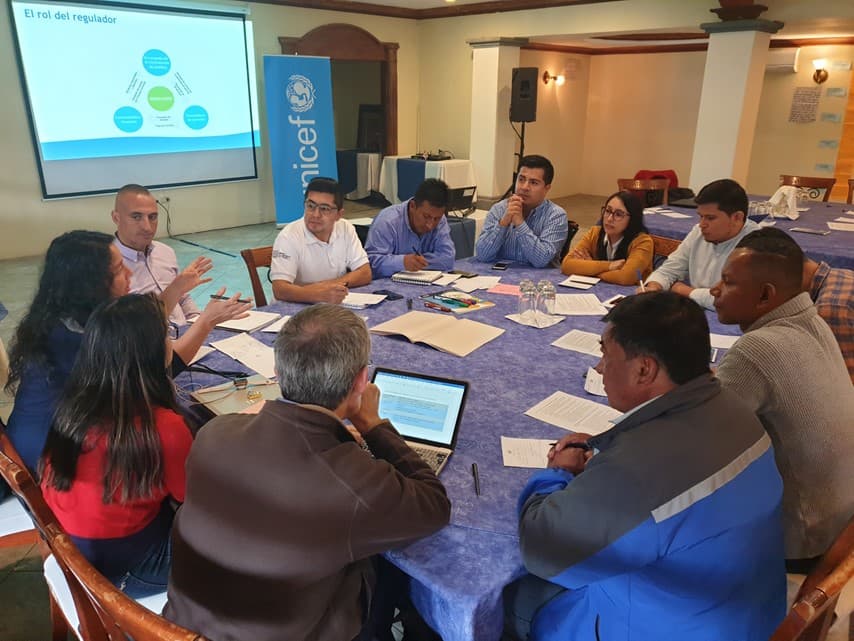

This article describes a collaborative effort led by the ‘Water and Sanitation Technical Working Group’ (MTT being its acronym in Spanish) of the Ecuador Emergency Operations Committee (MTT-1) to monitor, review, assess, and improve the WASH COVID-19 response at the national level. A variety of WASH stakeholders, together with relevant actors from other sectors (e.g., Public Health and Education), were engaged throughout the process, which was facilitated by UNICEF and the Stockholm International Water Institute (SIWI) during the first six months after the pandemic was declared, from April to September 2020. This response process built on a previous WASH sector bottleneck analysis, which was carried out at the end of 2019 and represented a major milestone in the development of plans for a more articulated and coordinated WASH sector in Ecuador.
The unprecedented declaration of a nationwide sanitary emergency in Ecuador in March 2020 activated the sectoral response mechanisms, as established by the national Committee for Emergency Operations (COE, its Spanish acronym). The COE is organized into eight technical working groups, with MTT-1 coordinating the response in the water, sanitation, and solid waste sector. It is tasked with creating the enabling environment for all WASH stakeholders to work together in the prioritization of the provision of safe water, sanitation, and hygienic conditions for everyone. Under this framework, UNICEF and the WASH cluster have provided technical assistance to the governmental sector institutions for ensuring a coordinated and coherent response to the emergency, which has included a diverse range of measures, initiatives, and actions. In Ecuador, the response has aimed to address the needs of the population which have arisen during the pandemic and the subsequent confinement and mobility restrictions, paying special attention to the needs of those in vulnerable situations, including populations on the move due to the migration crisis.
Before the crisis, the WASH sector in Ecuador faced a variety of challenges to provide sustainable and quality services for all, as identified in the National Drinking Water and Sanitation Strategy (ENAS, being its acronym in Spanish) (SENAGUA, 2015). These challenges include insufficient service coverage, mainly in rural areas, and poor quality of services, specially related to water quality and continuity of water services.
According to the latest data from the National Institute of Statistics and Censuses (INEC, being its acronym in Spanish), roughly one third of the Ecuadorian population does not have access to safely managed water services (Moreno, et al., 2020).
Access to sanitation is even more precarious as only 40% use safely managed services, 6% of the existing sanitation services are classified as unimproved, and 2% of the population still practice open defecation. The availability of a handwashing facility within premises with soap and water is about 90%. More than 3% of the households have no hygiene facility. In total, only 23% of the population has simultaneous access to water, sanitation, and hygiene (INEC, 2019).
At the onset of the pandemic , SIWI, together with UNICEF, developed an analytical framework to map 58 possible WASH responses being taken by sector stakeholders in different countries, as shown in Figure 1 below. This helped gain an understanding of how the sector was performing and reacting to the crisis, and how the situation evolved over time. In addition, the framework was adopted by the national coordination platforms in 10 countries of the Latin America and Caribbean region, and it proved to be a useful tool to structure the discussion around WASH response at country level.
|
|
 |
| Figure 1: Covid-19 WASH Response Mapping target areas Source: (SIWI, 2020a) |
Figure 2: Mapped measures in Latin America Source: (SIWI, 2020a) |
Ecuador applied this framework through a structured discussion to identify both the strengths and gaps of the response, and prioritize those initiatives needed to secure access to WASH for all (short- and mid-term), as well as to increase the resilience and sustainability of services in the long-term. This process showed that Ecuador had been active in 34 out of the 58 mapped response measures (Figure 2). This was the starting point for ten weekly sessions of remote technical support for the actors of the MTT1 which resulted in the development of various documents presented below.
 Key learning outcomes
The following points summarize the set of lessons learned throughout the process, which are described in more detailed in a separate publication. These considerations can be useful if other countries seek to replicate similar processes, at national or subnational levels.